Dance and Music at Metini / Fort Ross
Adding music and dance to your ELP program brings a wonderful element of culture and fun to the ELP experience! Although some groups show initial resistance to dancing, most students really enjoy it once they get going. We encourage you to bring musical instruments for your class to play and enliven your program, when possible. Any dances you plan to do while at Metini / Fort Ross should be learned and practiced ahead of time in the classroom. Traditional sacred songs and dances of the Kashia and Alaska Native peoples should not be practiced, but you are encouraged to learn about the rich dancing and music traditions of these peoples in a respectful way.
Kashia Pomo Music and Dance -
Music has long been an integral part of the lives of California Native peoples. Voices have been raised at ceremonial dances, at work and around campfires at night. Music has been enhanced by flutes of an elder, whistles, panpipes and flageolets of bone. There have been rattles of turtle shells, deer hoofs, split sticks, seashells, gourds and dried cocoons.
There are very few Pomo tribes which still uphold their traditional spiritual practices. The Kashia Band of Pomo Indians is one of the tribes that have carried on practicing these traditions. Some of the dances that are practiced by the Kashia today are original dances. Vana Parrish, the youngest daughter of the late Kashia Pomo spiritual leader Essie Parrish, describes some of their dances: Kashaya Pomo Dances.
- Kashia Men's Dances: Southwestern Pomo Indians by University of California, Berkeley
- Kashia Pomo Dancers at Fort Ross Festival 2019
- Dream Dances of the Kashia Pomo
Alaska Native Music and Dance - People all over the world use music and dance to tell stories, express themselves, entertain others, and connect with their heritage. In Alaska, there are many different music and dance traditions among indigenous cultures. We extend our heartfelt gratitude to the Alutiiq Museum for graciously granting Fort Ross Conservancy permission to utilize their website material for educational purposes. We highly encourage your classroom to consult the educational dance videos provided by the Alutiiq Museum to prepare a dance program for your class’ visit.
*** Dancing was a favorite activity at Alutiiq winter festivals. Moving to the rhythmic beat of skin drums, Alutiiq men reenacted hunting scenes and women danced in praise of ancestors. Performances were held in the men’s house, a large single-roomed structure built and maintained by a wealthy chief. Here men also met to discuss politics, repair their tools, and prepare for war. In the winter, Alutiiq people transformed this building into a ceremonial center. Here families gathered to celebrate the events of the year and give thanks to animal spirits for sustenance.
In preparation for dancing, people decorated the men’s house elaborately with hunting gear and animal skins. Paddles, harpoons, sea otter pelts, and even kayaks were tied together and suspended from the ceiling. Guests arrived in their finest clothing and sat according to their social position along the walls. Men sat on benches and women and children on the floor. As masked dancers appeared, the audience swayed and a person in the corner pulled on a rope to rock the gear hanging from the ceiling. This mimicked the movement of the ocean, adding ambience to the dance.
Today Alutiiq dancing groups continue the performing tradition. Dressed in ceremonial regalia, they celebrate and perpetuate the traditions of their ancestors with joyous songs and movements inspired by the wind, waves, animals, and history of Kodiak.**
REAWAKENING OF KODIAK ALUTIIQ DANCE - In the 1980s, a group of dedicated community members formed the Cuumillat’stun – "Like Our Ancestors” Alutiiq dancers to reawaken dancing traditions. This video traces their efforts to learn songs, make regalia, develop choreography, and share Alutiiq dancing with the world. Edited by Kodiak videographer Alf Pryo, with interviews by Tonya Heitman and historic photographs, and funding from the Alaska State Museum Grant-In-Aid program.
Cuumillat’stun - Like our Ancestors: Kodiak’s Alutiiq Dance History 1980-2015
CUTMEN AGNGUARTUKU - WE ARE DANCING FORWARDS
In July of 2011, Alutiiq dancers from across the Kodiak archipelago gathered for a workshop. With the help of Yup'ik dancer instructor Theresa John and drummer Agatha John, the group explored gestures, movements, and rhythms, then worked with Elder Alutiiq speakers to compose new songs in the Alutiiq language and choreography dances. Videos recorded the dancers' experiences and created a teaching resource to share with others dancers back home. This project received funding from the National Geographic Genographic Legacy Fund.
Modern Alutiiq Dance -
Craft Saturday - Dance Tutorial - This is a modern created dance inspired by traditional Alutiiq dance. This one may be practiced as it is open to the public and not a traditional, sacred dance.
More Alutiiq Dance and Music Videos -
- Alutiiq Dance Workshop
- Alutiiq Dance Songs
- Alaska Native Songs and Background Information
Russian Music and Dance - The Russian favorite - the Troika – can be done during the onsite program. Instructions for the Troika are provided below, along with other songs and dances you may wish to learn and incorporate into your ELP.
Please note Fort Ross Conservancy provides music for the Troika dance only. However, whenever possible, we encourage your class to provide your own music for the Troika — and any other music and dances that you may wish to do in class and during your onsite program.
Troika –
- Starting position – Sets of three facing counterclockwise in a circle: e.g. sets of three arranged like the spokes of a wheel. All hands joined at shoulder height.
- Starting with the right foot, take 8 straight-legged running steps forward.
- Repeat with 8 running steps backward.
- Retain joined hands. The right-hand person runs in front of the center person and through the arch made by the center and left hand person. The center person follows the right hand person, unwinding and all get back to their original positions. The left-hand person runs in place during this movement.
- Repeat the above movement, this time with the left-hand person going through the arch formed by the center and right hand persons.
- Join all hands together in circles of three dancers. Circle left with 12 running (or grapevine) steps. On measure 12, finish up with three steps in place.
- Repeat running circle in the other direction. Instead of finishing with three steps, break circle between the left-hand and right hand person. Center person runs forward to join 2 new partners.
- Repeat dance steps from the beginning until the song ends
Links to help learn the Troika –
Kids dancing the Troika at Fort Ross - Please note costumes are no longer permitted during the ELP.
Korobushka –
- Starting position – Double circle, men’s back to center, holding both hands (on hand hold, interlock tips of fingers with man’s palms up)
- Starting on man’s left (man going forward) and lady’s right (lady going backward), take one schottische step (Man – LRL Hop Lady – RLR Hop) away from center of circle
- Reverse direction, moving towards the center of circle. Repeat schottische step (Man – LRL Hop Lady – RLR Hop)
- Repeat beginning, with a schottische step moving away from center of the circle.
- Conclude with a Hungarian Bokazni step (Hop with feet crossed count l, Hop with feet apart – count 2, Hop with feet together – count 3)
- Face partner. Make 3-step turn to right, clapping on count 3. Make 3-step turn back to left, clapping on count 3
- Partners face and join right hands, shoulder high. Balance forward on right foot (towards partner). Balance back on left foot (away from partner)
- Retaining right-hand hold, man turns woman under his right arm and they exchange places.In opposite place, repeat section above, returning to original position
- Start dance again from beginning
It is believed that the men at Settlement Ross knew the songs Kalinka, and Beryozonka and longed for the melancholy melodies of their homelandMotherland. Certainly these very popular tunes might have been sung at the Settlement.
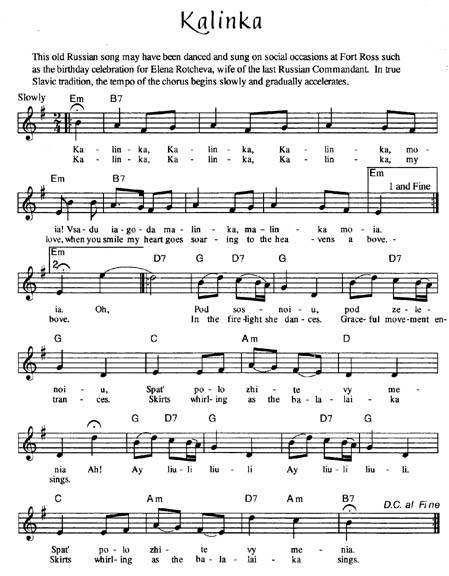
Kalinka – This old Russian song may have been danced and sung on social occasions Settlement Ross such as a birthday celebration. In true Slavic tradition, the tempo of the chorus begins slowly and gradually accelerates.
Starting position – Dancers stand side by side, facing in opposite directions
Each reaches across front of partner and places hand on partner’s waist
The girl carries a scarf in her raised free hand
The boy keeps his free hand raised also
As the tempo of the chorus begins slowly and becomes faster and faster, the dancers twirl in time to the music
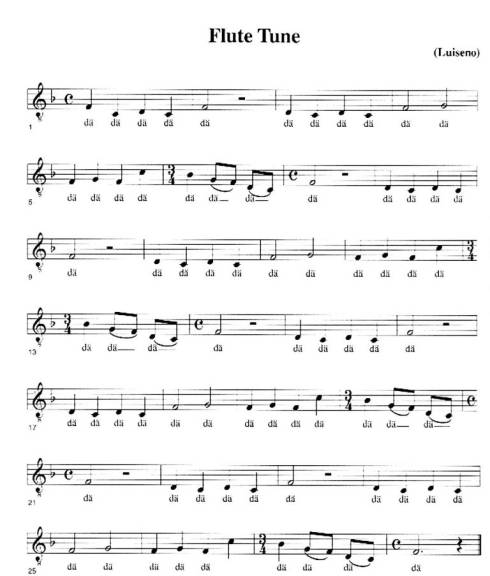
Flute Tune – A simple song, sung with just one syllable, Da. The following story is associated with it: “This is the Coyote song. The Coyote was the best flute player. Coyote sang da, da, da, da, while the rest of the people said sh! Sh! Shoo oo, oo, oo, so the Coyote was the best singer because the others got tired”.
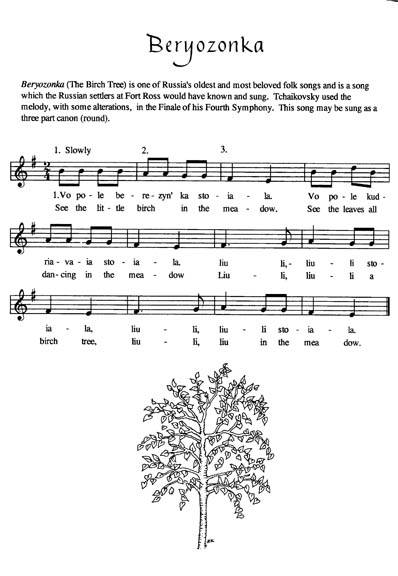
Beryozonka (The Birch Tree) – One of Russia’s oldest and most beloved folk songs and is a song which the Russian settlers at Fort Ross would have known and sung. Tchaikovsky used the melody, with some alterations, in the Finale of his Fourth Symphony. This song may be sung as a three part canon (round).
Peddlers performed by Beloe Zlato - Russian song video