Student Curriculum
Use this page to help teach your students about the history of Metini / Fort Ross. This historical summary includes information on the main peoples whose lives were intertwined at Metini / Fort Ross and goes through the three main reasons the Russian American Company established Fort Ross in 1812: Furs, Food and Trade.
Alutiiq Museum Difficult Discussions of Russian Era - A video created and presented by Alaska Natives on the difficult and at times tragic history of Alaska Native peoples during Russian colonization in Alaska. This story is a precursor to the Russian era history at Metini / Fort Ross. Teachers may choose to share this presentation directly with students or review it to determine how best to share the information with their students.
We currently do not have access to a video created by and presented by the Kashia Pomo people that touches on their history, including the Russian era at Metini / Fort Ross. However, this is in the works and we will share it as soon as it is made available. In the meantime, we encourage you to visit the official website of the Kashia Pomo Band of Indians to learn about the tribe’s past and present.
It is important to emphasize that the Kashia and Alaska Native people continue to live today. They are not a people of the past. Some Kashia tribal members live on a reservation that covers only a small part of their ancestral land. In 2016, a large parcel of coastal land was finally returned to the Kashia Band of Pomo Indians, the Kashia Coastal Reserve was established. Despite the settlement of Metini by the Russian American Company and the profound disruption to their daily way of life, the Kashia have survived. They have endured and have worked to preserve much of their culture.
Historical Overview
I. Who was and remains here?
Native Americans, including the Kashia (or Kashaya) Pomo, have lived in this beautiful spot for 12,000 years or more. They are among the oldest cultures in California. The Kashia Pomo lived full and rich lives at Metini, the place we call Fort Ross today, and their other ancestral lands. Throughout this website you will see references to “Metini / Fort Ross,” so that the original Kashia place name is recognized. For many thousands of years before the Russian fort was founded, the Kashia people lived at Metini and also in various villages and camps in the warmer, sunnier ridges above. The villages and camps were in places where the people could easily gather and prepare different food items, in harmony with the seasons. From the sea, the Kashia could gather nutritious food such as abalone, mussels, sea urchins, fish, and seaweed. On the land there were many different animals to hunt such as deer, elk, foxes, and bears. There were also many plants to gather for food: berries, seeds, roots, herbs, and the main staple of the Kashia diet, the acorn.
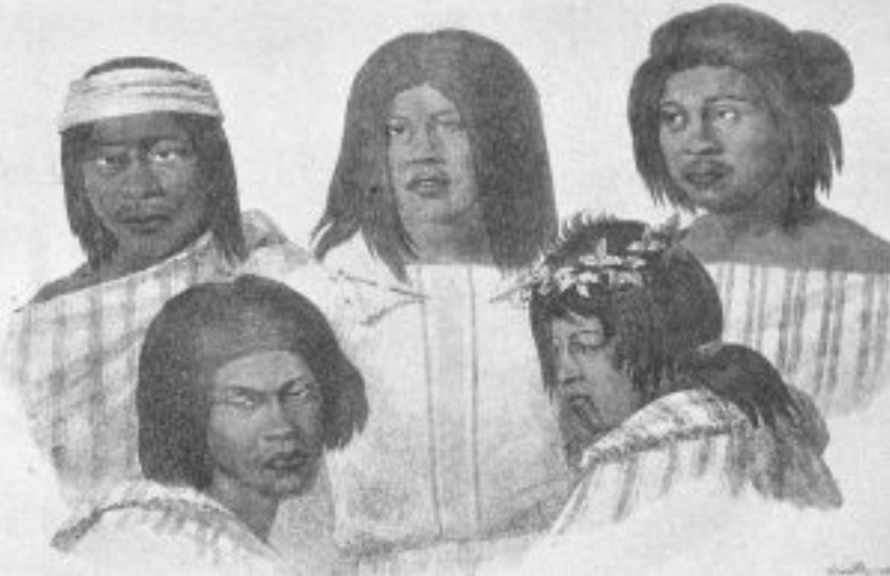
The Kashia had almost everything they needed for life here. The local trees gave wood for shelter and tools; the local animals provided food and furs for warmth. Tools were made from wood, bone, and stones like chert. Beautiful baskets could be made from local grasses and plants. The Kashia traded with other tribes to get items they couldn’t find on their own lands. One neighbor they traded with were the Coast Miwok people from the Bodega region. During the Russian era of Metini / Fort Ross (1812-1842), some neighboring tribes were also involved with the Russian American Company settlement at Metini / Fort Ross, being employed by the Company.
When the Russian American Company first sailed into the cove at Metini in 1812, life had already changed for many California Native peoples. The first Spanish mission was established in 1769 near San Diego, and more missions were established along the coast north to the San Francisco Bay after that time.
The Kashia Pomo had heard about the missions. They knew they did not want a mission on their land. When the Russians arrived, they told the Kashia that they would help to protect them from the Spanish as well as other Native Americans in the area. The Kashia could work for the Russians in exchange for things like beads, iron pots, tools, and cloth. The Russians also may have paid them for the land known as Metini with three blankets, three pairs of pants, two axes, three hoes and some beads. To see this ‘Treaty’ click here. At this time, communication between Kashia and the Russian American company may have been limited, it is interesting to wonder what may have been lost in translation.
Eventually, California Natives from several different tribes lived and worked here at Settlement Ross: Kashia Pomo from the lands surrounding Fort Ross, Coast Miwok from the area around Bodega Bay, Central Pomo from the lands to the north by Point Arena, and Southern Pomo from the Russian River Valley.
When Vasily Golovnin, Captain of the ship Kamchatka, arrived at Settlement Ross in the summer of 1818 he wrote: “The chief of the people living next to Port Rumiantsev came to see me when my sloop was anchored there. He brought gifts consisting of various parts of the regalia, arrow, and household items, and asked to be taken under Russian protection. An Alaska Native…who had lived over a year among these people acted as interpreter. This chief, called Valentila, definitely wanted more Russians to settle among them in order to protect them from Spanish oppression. He begged me for a Russian flag, explaining that he wanted to raise it as a sign of friendship and peace whenever Russian ships should appear near the shore…”
II. The Beginning of Settlement Ross
A long time ago, in 1812, there was a big change in California. That was the year Fort Ross was established by the Russian American Company at Metini. Why in the world did the Russians come here? After all, California is a long way from Russia! In fact from the Company’s headquarters in St. Petersburg to Metini / Fort Ross is 5,610 miles! That is more than two times the distance from New York to Fort Ross (2,540 miles).
Use the map to follow the route from Fort Ross to Sitka, then across the Bering Sea to Siberia, then across Siberia to St. Petersburg. It really is a long way!
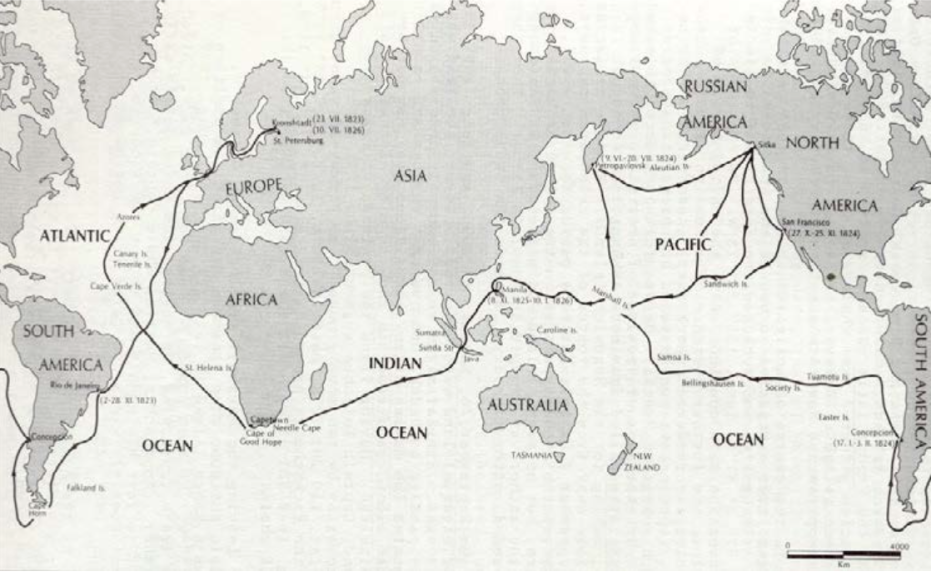
Why did the Russians go to Alaska? Almost all the people who came to work at Metini / Fort Ross in 1812 came from Alaska, not from mainland Russia. Alaska Native people were subjugated by the Russians and were forcefully taken to California to serve the Company. Today Alaska is part of the United States (it became our 49th state in 1959). In 1812, when Fort Ross was founded at Metini, it was not a part of the United States, but a part of the huge Russian Empire. The Russian America Company (RAC) (PAK in Russian), was given a charter by Russian Czar Paul 1 in 1799. With that charter, the czar (the ruler of all Russia) gave the Company the right to settle in Alaska, against the wishes of the Alaska Natives, and without their consent and to make it part of the huge Russian Empire. The monopoly included the land, mineral rights, animal rights, military protection and the right to build ships in Alaska. The Company was granted the sole right to establish trade relations with foreigners. So, what do you think the Russians were doing there? As it turns out, they were doing many of the same activities that they would later do at Metini / Fort Ross.
III. Sea Otters
Some of you may have seen sea otters at an aquarium or zoo, or if you are lucky you may have seen some frolicking in the Pacific Ocean near Monterey. These otters are the reasson that the Russians journeyed to far away Alaska. The Russian America Company sought to trade in Sea Otter fur.
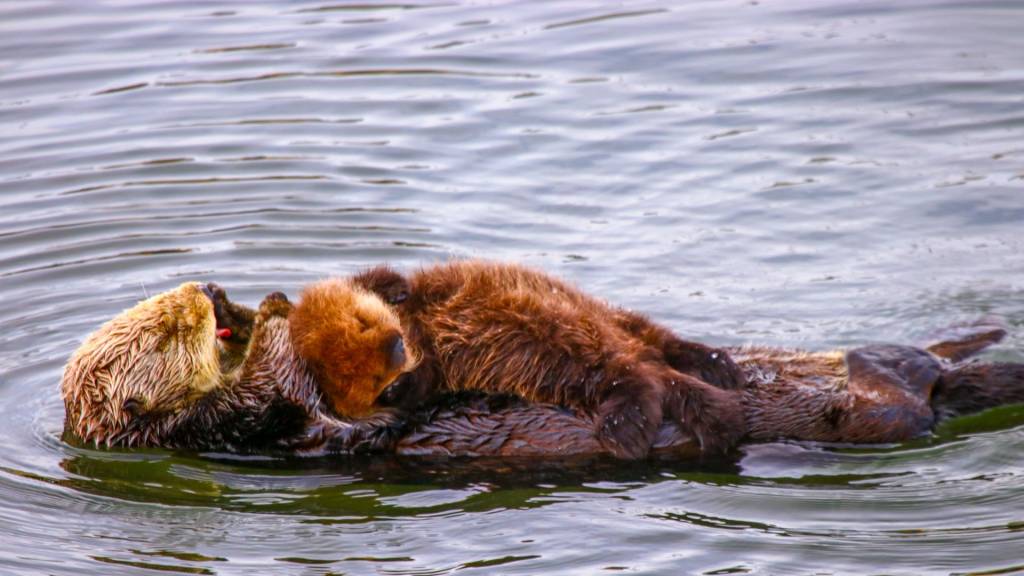
The fur of the sea otter is very, very thick and soft. One square inch of sea otter can have as many as one million hairs – as many hairs on it as an entire dog! That means that sea otter fur is not only very soft and beautiful, but is also very warm. Otters need that nice coat to keep warm in the cold ocean, but unfortunately for the poor otters, humans could also use their pelts (the skin and fur of an animal) to make warm things to wear. Sea otter fur was so warm and nice that it became the most valuable pelt in the world. One sea otter pelt could be worth as much as it took for three people to live for one year!
Sea otter pelts could be traded all over the world to make money. The Russian hunters living in Alaska were better at hunting animals on land than on the ocean. So they forced Alaska Natives from many tribes to hunt the sea otters for them, while their families would be held hostage. The Alaska Natives were highly skilled experts at hunting in the ocean. Not only had they developed an incredible skill at hunting sea mammals such as the sea otter, but they nurtured relationships with the animal communities on which they relied . The RAC forced practices which disrupted these cultural traditions of respect and balance which would lead to the Alaskan sea otter being hunted to almost extinction.
To kill a sea otter, the hunter must go out in the water where the otters live and feed. To do that, he/she must have a small and agile boat. All coastal people from Alaska to Greenland used skin on frame kayaks with special designs based on where they lived and what their challenges were. Alaskan kayaks or "qayaq" were perfect for the task at hand, but not just anybody could jump into one and go out on the dangerous Pacific. Alaska Native hunters were trained as young children in the skills that they would later need on the water. These boats were engineering marvels. The double- bowed kayak use by Kodiak and Aleutian islanders were so sophisticated, even 9000 years ago, that the U.S. Navy still uses their design today.
A hunter also would need the right weapon to kill a sea otter. A gun wouldn’t really work because it left big holes in the valuable fur, and the gun’s loud bang made the sea otters scatter. Also, how would the hunter get the otter he/she had shot? A wounded otter would swim away, and a dead one would sink. Alaska Native hunters used the throwing board and harpoon also called the atlatl. The harpoon had a seal-bladder float attached to it which would allow the hunter to keep track of the otter which he/she had hit. The hunters would usually go out to hunt in groups of twenty to thirty. The hunters would surround the otters and take aim as the otters came to the surface to breathe. For more history on the Sea Otter click here.
IV. Food
Think about Alaska for just a second. What is the first thing you think of? Most people think right away of cold and snow. Burrr, long cold dark winters and short cool summers. The Russians had a very hard time growing the food that Russian settlers desperately needed. The Russians missed the foods from home — like bread, soups, and cheese.
People from the RAC frequently became sick with a disease called scurvy because they didn’t have enough familiar fruits and vegetables to provide Vitamin C for their diets. Because the Russians were new to Alaska, they struggled with figuring out what to eat, how to hunt, and prepare the available resources. With the Alaska Native men busy being forced to hunt for furs rather than being allowed adequate time to hunt for food, Alaskan Native families also experienced hunger and scarcity.
In the 1800s, it was much harder to move things from one place to another. It was especially hard to move something like food, which doesn’t keep forever. To get food to Alaska from Russia, the Russians had to move it at least 2000 miles, a journey that could take two years! Just think what some of that food might have looked or tasted like when it finally got to the hungry Alaskan Colonists.
V. California: A Solution to the Russian American Company’s Problems
Establishing a settlement in California could solve the Company’s two biggest problems: getting sea otter fur for profit and food to eat. By 1806, there were not many sea otters left to hunt in Alaska. In California, there were as many as 300,000 sea otters. California sea otters lived along the Pacific Coast from Baja California all the way up to today’s Oregon border. The Spanish, who claimed control over California in 1812, sometimes hunted the sea otter, but did not have the skillful Alaska Native hunters subjugated by the Russians to hunt for them. The Russian American Company saw the California sea otters as a way to continue the valuable fur trading, using forced Alaska Native labor.
The second solution that California provided to the Russian American Company probably seemed far more important to the growling stomachs of the Alaskan colonists: Food! Although California is many miles from Alaska, it was much easier to sail on a ship from Alaska to California than it was to transport food all the way across Russia to Alaska.
The Spanish missions’ gardens and fields were growing so much food that the Spanish colonists couldn’t eat all of it. This was largely due to the native slave labor at the missions. Spanish colonists and missionaries were very happy when they found out that the Russians wanted to buy or trade goods for their extra food. The Russians had many items that the Spanish really needed: things like iron for making plows, nails and tools, redwood barrels, rowboats, wheels, nice cloth for making clothes, linen for the tables, glass for windows, and black powder. The Spanish had the kinds of food that the Russians wanted and needed most: beef, grains for bread, and fruits and vegetables.
VI. Building a colony, hunting base, and trade center
There was another way that the Russians could get food in California. Food can be cultivated and grown.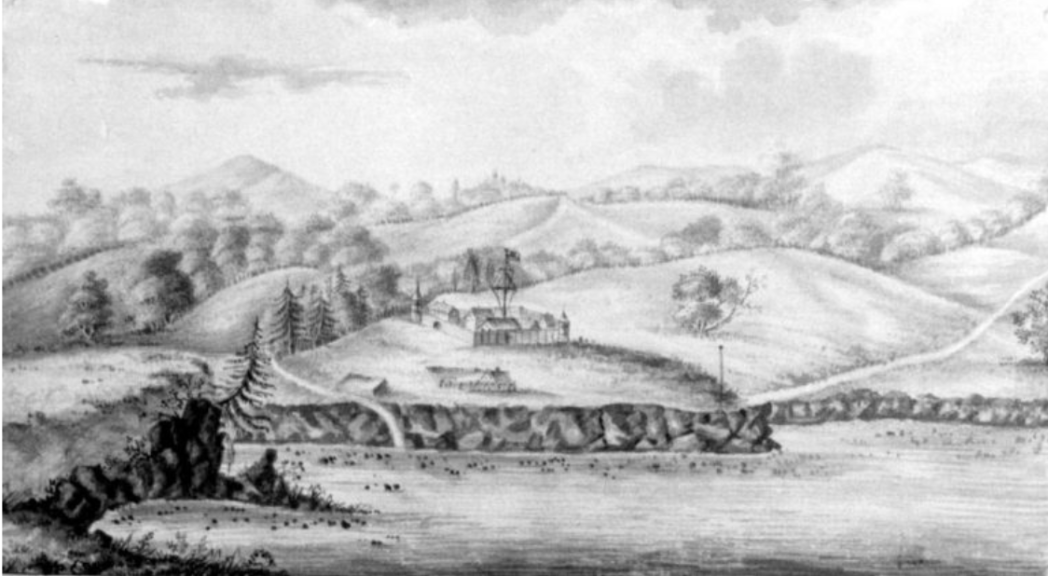
Alexander Baranov, the Chief Manager of the Russian American Company in Sitka, Alaska was very interested in setting up a new settlement in California. So in 1808, he sent his agent, Alexander Kuskov, to select a spot where he could build a new settlement.
Kuskov looked at many locations along the Northern California Coast before he found just the right one, twelve miles north of the Slavyanka (today Russian) River. The place he chose had two beautiful coves at the bottom of small but steep cliffs. Above the cliffs, was a long flat piece of land which Kuskov thought could be used for fields to grow food and pasture for animals. Above the flat land were steep and tree-covered hills. The hills made it difficult to attack the site by land so the fort could be easily protected. Also, the trees covering the hills would be needed for lumber to build the fort structures.
In March of 1812, Kuskov arrived on the site with twenty-five Russians, and eighty Alaska Natives. Many of the Russians were skilled craftsmen who could help to build the settlement. The Alaska Natives were also craftsmen who would help build the settlement, but their contribution to the construction efforts over the years have barely been acknowledged in the historical records. For the Company, possibly one of the most valuable things that the Alaska Natives brought with them were their well-crafted baidarkas for hunting sea otters. By September 10, 1812, the stockade was complete.
The Company holdings extended as far south as Bodega Bay, where Port Rumianstev at Bodega served as their main port. Over 200 hundred ships came through this port during active trading years. Most supplies and furs were kept in warehouses at Port Rumianstev. Other RAC holdings extended to inland areas where several farms were built up. The Farallones Islands, west of San Francisco, were used as a hunting base for the Company. Click here for more information about the Farallones.
VII. What was Fort Ross like?
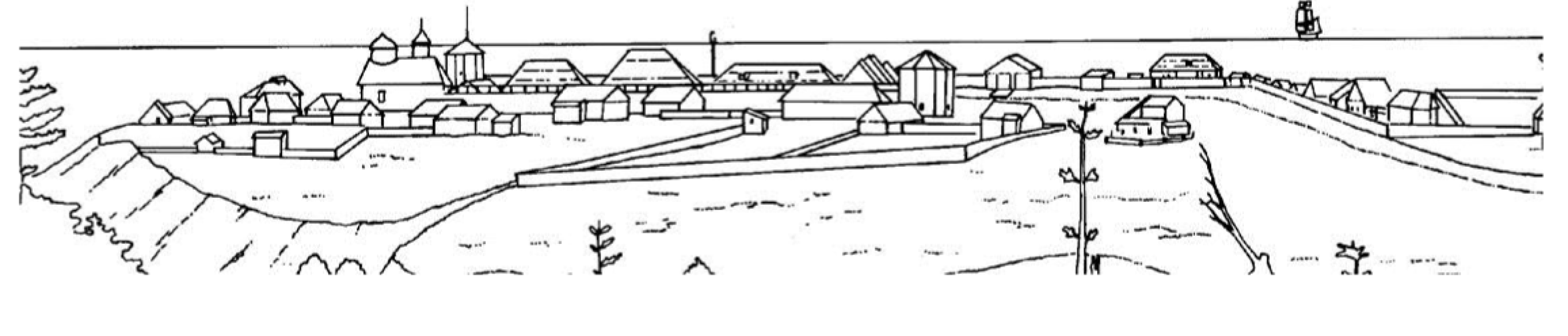
"Fort Ross". The word ‘Ross’ comes from a Russian word, Rossiya, which means ”Russia.” But, the Russians didn’t usually call this place Fort Ross, they called it “Settlement” or “Colony” Ross. An outpost such as this would always have an enclosure called a fort. Even though there was never a battle fought here, they had as many as 42 cannons! Most of the cannons which the Russian American Company acquired for use or trade at Metini / Fort Ross were British or American made iron pieces. Some cannons were also brought from Sitka, possibly being Russian bronze guns.
Settlement Ross looked very different in the old days than how it looks today. When the Russians sold the fort to John Sutter in 1841, there were fifty-nine buildings. The fort compound would have been pretty crowded if all of those buildings were inside, and in fact, only nine of the buildings were inside the walls.
Almost all of the people who worked at the settlement lived outside the fort. The coerced Alaska Natives lived out in front of the fort on the bluff called the Alaskan Neighborhood. Their houses, at least in the beginning of the settlement, were probably similar to the houses that they had built and lived in Alaska. The houses were low to the ground because they were built half above-ground and half under-ground. Alaskans likely built their houses this way because it is warmer and easier to heat.
Many Kashia and Coast Miwok women married Alaska Native men who were brought here, and lived with them in their neighborhood in the front of the fort compound. It might have seemed strange to the Kashia and Coast Miwok women to live on the windy, foggy bluff when the weather is so much nicer up in the hills protected from the elements. The California Native men who came to Settlement Ross for work had a barracks building to sleep in, near the Alaska Native neighborhood.
Outside the fort was an area called the sloboda where there were about twenty-eight houses. The houses were sturdy Russian-style buildings made of redwood. Many of the Russian employees lived there, sometimes with their Alaska Native or California Native wives. Also surrounding the fort compound were the many buildings which were necessary for agriculture and industry: barns; workshops for working with wood and metal; a ship works; a tannery; two windmills for grinding grain; and the Russian style bathhouses.
The buildings inside the fort compound itself were mostly living quarters for higher ranking employees and storage for important and valuable goods like food, furs and trade goods.
There were five different managers of the Ross Settlement. The first four lived in the two-story Kuskov house. The last manager, Alexander Rotchev, lived with his family in the building we call the Rotchev house, the only original structure left standing today from the Russian era of Metini / Fort Ross. The Officers Barracks (OB) or Official’s Quarters was used to give Company officials, or ships captains visiting the fort, a place to stay.
There were also two warehouses: one for food, one for trade goods. There was a kitchen building where food for the people who lived in the compound was cooked. The chapel was built in 1824 so that the Russian Orthodox inhabitants of the settlement could have a place to pray and hold services, although there was never a full time priest here in residence. The two blockhouses and the tall fort walls were important in case there might have been an attack on the fort, although there never was an attack or a battle. 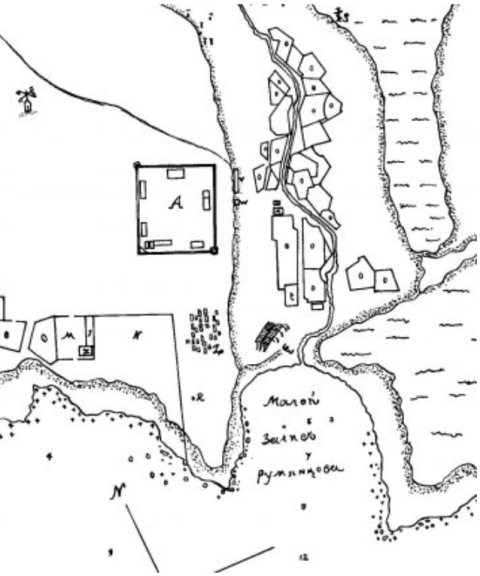
In response to a demand from Spain for information about Settlement Ross, Russia sent a copy of this map to Madrid in 1817. The stockade (A) contained only five major buildings and two workshops at this time. The chapel was not yet built. Also included are the Alaska Native dwellings on the plain in front of the fort, the windmill to the north, the vegetable gardens in the gulch below the fort, the cemetery (S) and the shipyard on the beach.
VIII. Who lived at the settlement? What did people do? How were they paid?
Life at Settlement Ross was very busy. It was a lot of work to keep everything running smoothly, to keep all the people fed, and to make a little money. Everybody had jobs and responsibilities. The Ross Manager took his orders from the Chief Manager in Alaska and it was his job to keep everything at the settlement running smoothly.
Russians – There were three types of Russian workers who lived here:
Prikashchiki (prik-asch-chi-ki) were supervisors, the men who acted as the bosses of the work crews either located at Ross or the other outlying ranches.
Next were Artelschiki (art-els-chi-ki) skilled craftsmen — men who could do things like build houses, furniture or ships, make barrels, or blacksmiths. Fine ships were built by the Russians at Sandy Cove, below the fort. The first altar fixtures for Sonoma Mission were made by the craftsmen at Ross. Mariano Vallejo relied upon Russian blacksmiths in the early years of the Petaluma Adobe. Other tasks that the Company employees worked at were brickmaking, musket repair, logging, building houses, and coal mining.
Most of the Russians were promyshlenniki (pro-mysh-len-niki). While skilled fur trappers, a Promyshlennik might also do general labor, like working in the sawmill or helping to take care of the animals and fields. Sometimes, they might also go hunting for pelts or fur, or be a sailor on a Company ship. The promyshlenniki at Metini / Fort Ross were generally seen as unmotivated and poor agricultural workers. When they did have time they would tend their own plots instead of the Company fields. One Russian hunter, who possibly ran away from the Company, roamed much of Northern California, while another was reported to have worked the Snake River of Idaho for the Hudson Bay Company. Click here for the contract with the Company, a primary document.
As far as we know, there were no Russian women who lived here until the arrival of the last manager, Alexander Rotchev, who brought his wife Princess Elena and their children. They were also accompanied by their maid, possibly a Russian woman.
It is very important to remember that Russians were usually the smallest group here at the settlement. Of 179 men accounted for at Ross in 1820, only 38 of them were Russian.
Alaska Natives – There were many different Alaska Native peoples who lived at the settlement. Alaska Natives were taken from the Aleutian Islands, Kodiak Island, Kenai Peninsula and other coastal regions in Alaska were classified collectively as “Aleuts” in most Russian documents. However, since many of the Alaska Natives weren’t from the Aleutian Islands, the term isn’t considered appropriate today. (We recommend visiting the Alutiiq Museum Website to learn about the Alaska Native Alutiiq / Sugpiaq peoples. The Alaska Natives, forcefully taken to California by the Company, worked as sea-mammal hunters, general laborers, and skilled craftsmen. There were also a few Alaska Native women who were the wives of Company employees. It is important to remember that because their importance to the Russian American Company as highly skilled hunters, Alaska Native peoples were the most populous group at the settlement.
Persons of Mixed Heritage - There were many marriages between Russians, Kashia, Coast Miwok, and Alaska Native peoples. Eventually there were more persons with mixed heritage in the Russian Colonies than Russians, and they were considered to be Russian subjects. The Russian American Company educated them, some served in important positions as officers on Company ships and as mid-level managers, clerks, and skilled craftsmen. They were issued, at Company expense, clothing worn by sailors, two pairs of boots, and one kamlei, at a cost of about 35 rubles. Master coppersmiths, tinsmiths, and blacksmiths were generally persons of mixed heritage and were well versed in their crafts. These skilled artisans were well paid and important to the Company’s needs.
Californian Natives – The California Native men who worked for the Company mostly worked in the Company’s grain and vegetable fields, and helped tend to the animals raised there. They were paid mostly with flour, meat or clothing, either at the end of a day’s work or at the end of a month’s work. In the early years of the settlement, the California Natives worked for the Company voluntarily. As the years went by, they didn’t want to continue to do the hard work for the very little, and unfair pay that the Company gave them - understandably so!
The California Native women who lived at the settlement probably worked in the fields, too. Sometimes, the Company also had them sew garments for the settlers. The Russians trained the women to spin yarn from the wool of the sheep at the settlement and weave blankets from it. Women also worked gathering and preparing food for their families.
Children at Ross – What about kids? So far as we know, there was not a school for the kids. Children would have been just as busy as adults at Settlement Ross. Water needed to be carried to the houses for cooking and cleaning. Wood had to be gathered. Many of the residents had small gardens of their own which needed tending, watering and weeding. Shellfish like mussels and abalone could be gathered from the water’s edge. Local wild plants and berries needed to be gathered. Children also sometimes watched over the Company’s cattle and sheep herds, keeping the animals from straying away or getting into the Company fields.
Agriculture – From 1821 to 1825, under the management of Karl Schmidt, agriculture was expanded. Settlement Ross was possibly better supplied than the Spanish Missions. The settlement grew wheat on the land surrounding the compound. California Native workers harvested the wheat and tied it together. Several threshing floors made of planks, or packed-down earth, were used to process the grain, which was sacked and stored in the warehouses. At least one windmill was in operation where grain was ground and sacked.
Unfortunately for the Company, the agriculture efforts at Settlement Ross were never really successful. Wheat harvests were poor due to coastal fog, gophers, and strong winds. By 1839 the Company started purchasing grain and beef from the Hudson Bay Company which operated to the North.
Pay and Salaries – Most everybody at the settlement were paid very poorly for their hard work, including the Kashia Pomo, Coast Miwok, Southern Pomo, Russians and Alaska Native peoples. After 1818, the Russians were paid a regular salary in “Company scrip.” Company scrip was sort of like money, but instead of being made by a country or government, it was made by the Russian American Company. It was only good for buying things at the store owned by the Company. 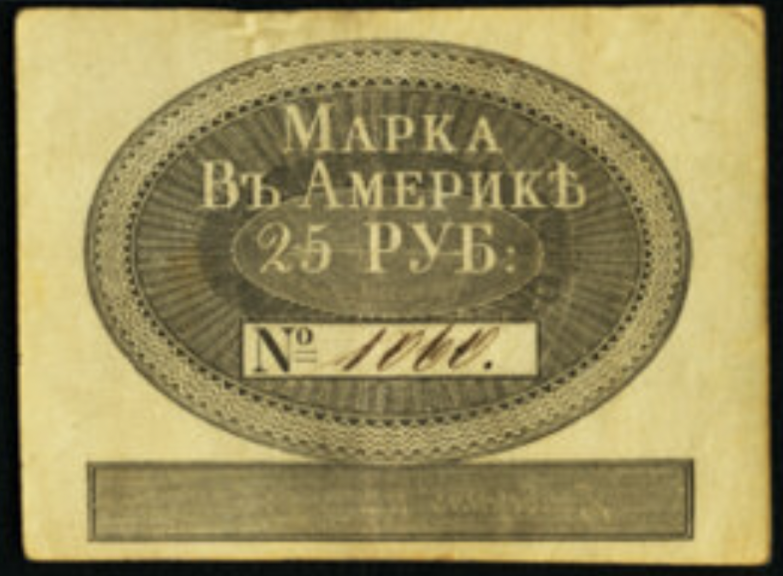
Most of the time, the employees weren’t paid enough to get the things that their families needed to survive, and so they borrowed from the Company store. As their debts got bigger and bigger, it got harder and harder to stop working for the Company. The Company did reward those who worked extra hard. They would get a bonus.
Click here for more wage information.
IX. Why did the Russian American Company leave?
In 1841, after twenty-nine years in California, the RAC finally decided to sell what it had built here. The reason that the Company had to go was quite simply that they couldn’t make any money. The number of sea otters had dramatically decreased from overhunting along the California coast by 1820. The valuable fur seal had almost disappeared. That made it very difficult for the Company to continue the profitable fur trade.
Even though the Company had tried very hard to grow enough food at Metini / Fort Ross to feed settlers in the Alaskan colonies, they weren’t very successful. Most of the people who lived here didn’t know too much about farming, and in addition, didn’t really want to spend all of their time toiling away in the Company fields for not enough pay! The cold, foggy weather on the coast, and the millions of gophers that live here didn’t help either. Most of the colonists had enough to eat, but couldn’t grow enough to supply all of Alaska too.
The Ross Settlement had always cost the Company more money to run than it made. From 1838 to 1841 the Company spent 77,000 rubles to run the colony, and only made 26,000 rubles. That means it cost the Company 51,000 rubles just to keep Fort Ross going! Finally the Company officials in St. Petersburg gave up.
When the Company left, almost all of the people who worked in California were sent back to Alaska. Some of the California Native women returned to their people while others went to Alaska. The Company also took many of the items that they had brought to California, such as cannons and muskets. But they left many valuable items behind too. There was a lot of glass, something hard to find in California at the time. There were pre-cut timbers and whole buildings that could be taken apart and all of the important materials reused. There were also uniforms, plows, two windmills, cattle and horses.
They sold everything they left to John Augustus Sutter, who wanted to buy the things so he could build up his own settlement, “New Helvetia,” near Sacramento. Sutter could only buy the things that the Russians left, not the Kashia land, which the Russians did not own, but leased – the land was now claimed by the Mexican government. John Sutter bought all that the Russians left for $30,000. He promised to pay the Russians in payments of grain and food and money. Click here for a ‘Bill of Sale’ to John Sutter, a primary document.
X. After the Russian American Company
As soon as the Russians left, Metini / Fort Ross began to change. Metini / Fort Ross went from the Russian era to the Ranch era. Sutter had many buildings torn down so that he could reuse the wood. After Sutter, many different people owned the land. All of them used and reused the buildings that remained from the Russian days. Buildings rotted and fell over or burned. Slowly but surely, the old Russian buildings disappeared.
Fort Ross became a State Historic Monument in 1906, just before the big “San Francisco Earthquake.” The earthquake was very strong here because Metini / Fort Ross lies very near the San Andreas Fault. Most of the few buildings that were still standing from the Russian days were badly damaged in the shaking. Slowly, buildings are being rebuilt.
Rotchev House is the only building left standing from the Russian days.
Student Curriculum Review Questions –
Section I Questions:
- On whose land was Settlement Ross established?
- What is the original name of Fort Ross State Historic Park in the language of this land’s original inhabitants?
- How long have the First Nation inhabitants been stewards of this land?
- Who were called the “undersea people”?
- In what ways do you think that the lives of the Kashia Pomo and Coast Miwok were changed after the Russians arrived here?
- Think about the five items that the Russians may have given to the Kashia as payment for Metini. Do you think that it was a good trade? Tell why or why not.
Section II Questions –
- What year was Fort Ross established?
- What is the name of the Company that established Fort Ross?
- What country claimed control over Alaska before it became an American State?
Section III Questions –
- What was the most valuable pelt in the 1800s? How much could one pelt be worth?
- Who did most of the hunting of these animals for the Russian American Company? Why?
- Do we have sea otters in California today?
Think about it –
- What influence do you think the Russians had on the Alaska Native people's diets?
- Today many people feel that it is bad to kill animals in order to turn their fur into clothes. Do you think that people in the 1800s might have felt differently? Give some reasons why.
- What might have been an important rule for the Russians to follow about how many otters to take?
- Describe what “extinction” means. The Russians, along with other peoples, almost hunted the otters to extinction. Do you think that they cared? Why? Are animals still being hunted to extinction today? Why?
- Do you think the Alaska Native peaoples have had different rules for hunting otters than the Russians did at this time?
Section IV Questions –
- Why didn’t the Russians just eat the food that grew in Alaska?
- How long did it take for food to get to Alaska from Russia?
- What disease is caused from not getting enough Vitamin C?
- What do you need to eat to get vitamin C?
Think about it –
- Why do you think the Russians didn’t eat the same things as Alaska Native peoples?
- How do you think food was prepared and packed to be sent on a two year voyage? What kinds of things might happen to it on its way?
- How long do you think it takes for the food you eat to get to your table? What sorts of transportation are used to move different foods today? Would you miss the food you like?
Section V Questions –
- List the RAC’s problems that could be solved by having a settlement in California.
- What could the Company get from the Spanish missions’ farms and fields?
- Why did the Spanish missions have extra food to trade with the Russians?
- How did the Russians get from Alaska to California?
Think about it –
- How do you think the Spanish felt about having the Russian American Company hunting otters in California?
- Why didn’t the Spanish have things like iron and glass? Where did items have to come from to get to Spanish California for the settlers living here at the time?
Section VI Questions –
- What was the name of the man who found the site for Settlement Ross?
- What were some reasons the Russian American Company chose Metini as the place to establish Settlement Ross?
- The fort is twelve miles north of what river?
- How many people came from Alaska to California to establish Settlement Ross?
Think about it –
- Although the Spanish did not have any settlements north of the San Francisco Bay, they did claim the land the Russians took to build the fort. How do you think they felt about having the Russians on “their” land?
- If you were an Alaskan Native who was forcefully sent to California, how do you think you would feel? Why? How might your whole family be affected?
Section VII Questions –
- What did the Russians call Fort Ross?
- Was there ever a battle?
- How many buildings were there in and around the fort compound?
Think about it –
- The buildings at Settlement Ross were mostly made of redwood. Make a list of the things besides wood might you need or want to build a building. Where would materials come from? What could you make from things found in California?
- If you were one of the people who lived outside of the fort walls, do you think that you would rather have lived inside? Why and why not?
- Use your nose for a minute. List some of the smells that may have been created from industry, agriculture and the people living here at this site.
Section VIII Questions –
- How were the Company employees paid?
- Which peoples lived at Metini Fort Ross in the Russian era? Which group was the largest?
- The Russian American Company often referred to the Alaska Native peoples present at Settlement Ross as “Aleuts.” Why do we think this was not a good name to use? Why could this be seen as disrespectful?
- Why were muskets a poor weapon to hunt sea otters? List three reasons.
- What is the name of the weapon that the Alaskans used to hunt the sea otters?
- Why wasn’t agriculture successful at Settlement Ross?
Think about it –
- How do you think the Alaska Native employees felt about coming to California? How about Russian employees?
- If you were an Alaska Native, do you think you would rather be paid a regular salary or according to the number of pelts you brought in? Why?
- Think about Company scrip. Discuss some of the advantages and disadvantages of only being able to spend money at a store owned by the Company.
- Do you think that it would have been more fun to be a kid today or in the days of Settlement Ross? Why?
Section IX Questions –
- Why did the Company leave California?
- What was left behind at the settlement?
- Who bought the belongings the Company left behind?
Think about it –
- If there was one part of Settlement Ross that you could rebuild or visit in a time-machine, what would it be and why?
- Most of the Company employees left with the Company. Some of those Company employees had come from Alaska and some had been born at Ross. How do you think each group would have felt about going to Alaska?
- There were big changes in California after 1841, like the Bear Flag Revolt, the Gold Rush, and statehood. What do you think might have happened if the Russians had stayed on?
Here are some Extra Credit questions for in class and while you’re at Metini / Fort Ross –
In Class Questions –
- What is The Russian American Company?
- What does a charter mean?
- What was the purpose of the Company in Alaska?
- Why did the Russians come to Alta California? In what year?
- What role did shipping and trade play in the business of the Ross Colony?
- Who were the Alaska Natives and what work did they do for the RAC?
- Who were the California Natives and what work did they do for the RAC?
- What do you think life was like for the California Native peoples within the Russian American Company?
- How were they paid for their services to the Company?
- List four trade items between neighboring tribes and list four items that were traded between the natives and the Company?
- Did the Company have a treaty with the native peoples here?
- Were there marriages between the California Natives, the Alaska Natives, and the Russians?
- What was the relationship between the Russians and the Spanish Californians and the missions?
- When Alta California became Mexican territory in 1822, what was the relationship like with the RAC?
- What other ranches and ports did the Russians have in California?
- How many Russian women do you think lived here at Ross?
- How were the basic needs supplied at Ross? i.e. water, lighting, clothing, food, etc?
- What would a normal workday at Ross be like for an adult and for a child?
- What land animals were hunted at the Settlement Ross?
- How did the people of Ross travel around California?
- Was Fort Ross a military establishment or more of a hunting and trade post?
- Why do you suppose the Russians built such big walls and had so many cannons?
- If this is not a military post then why is it called Fort Ross?
- Who bought Fort Ross from the RAC?
- Who runs the park today? How large is the park today?
Questions while you’re at Metini / Fort Ross –
On getting to Metini / Fort Ross –
- How many rivers and creeks did you cross?
- What are the names of the rivers and creeks?
- Were any named after the Russians?
- What does the countryside around Metini / Fort Ross look like? How does it differ from your area?
Fort Compound and Surrounding Areas –
- Why was the fort compound built? Was there ever a battle at Fort Ross?
- Estimate the size of the fort compound.
- What wood is the fort constructed with?
- How are the walls put together? How tall are the walls? Just estimate. Are the walls put together with nails?
- How many buildings are inside the fort compound today? Were there more? How many do you think?
- What is the largest structure in the compound?
- Do you see the chapel? What religion was practiced here in this chapel? Were there other religions? What are the sand boxes in the chapel used for?
- How many seats does the chapel have? Why?
- How deep is the original well?
- Did most people live inside the fort compound? Or outside?
- Where did the Alaska Natives live? The Kashia? The Russian laborers? The families?
- Do the two blockhouses have the same number of sides? Explain?
- How many bedrooms in the Officer’s Barracks?
- In the dining room is the table one piece of wood? What kind of wood is the table?
- What fur is hanging on the wall in the room with two beds?
- Describe the two workshops. Explain the use of one of the tools you see. Identify five tools from the two rooms.
- Have you noticed the fireplace in the Officer’s Barracks? Did they cook here?
- How many rooms are in the Rotchev house? Who lived here? Did any kids live in this house?
- Who would have used the loom, men or women? Or both?
- How many rooms are there in the Kuskov house?
- In the trade store describe three items you see that you would use today.
- Make a sketch of your favorite building.
- Outside the gate facing the ocean describe what you see, hear, and smell? Are you facing west or south or north?
- How many buildings were outside the fort compound?
- Lean against the wall outside the compound. Is it warm or cold?
- Looking at the ocean do you see or hear any sea otters? Any harbor seals, sea lions, or walruses?
- Do you think Metini / Fort Ross would be a good place to live? What do you like about this place?
Visitor Center Hunt –
- What was the name of the Kashia village that was located here?
What does the name Kashia mean?
- What kind of homes did the Kashia live in? How many families lived in a home?
- What items have the Kashia been famous for making so skillfully?
- Name five foods the Kashia or Coast Miwok would eat.
- Who was the first manager at Ross? The last? Can you list all five managers?
- List three reasons the RAC came to California?
- What year did they establish Fort Ross at Metini? What year did they leave?
- List one Spanish leader when the fort was being built.
- List three reasons why you think they choose this location?
- What kind of fruits and vegetables did they grow here? List five.
- What kind of livestock did they have at Ross? Name three.
- List three other things the Russians would produce here at Metini / Fort Ross.
- How many Alaska Native kayaks are in the Visitor Center? How old do they look?
- What was the major fur trade item here and with whom was the Company trading this fur? And what goods did the Company receive in exchange for this fur?
- What is the hair density of the otter fur pelt? If you are not sure just take a guess.
- What is a baidarka? Sketch one.
- Who purchased Fort Ross’ immovable property and why? How much was paid to the RAC?
- List three reasons why the Russian American Company left the Ross Settlement.
- What was happening in other parts of California at this time? In other parts of the United States?
- Do you think the Russians would have stayed here at Ross if they knew the Gold Rush was coming?
More Critical Thinking Questions -
- What were some of the challenges faced by Alaska Natives who were brought to Metini / Fort Ross against their will to work for the Russian American Company in California?
- How did the Alaska Native peoples' experiences at Metini / Fort Ross differ from their lives and traditions in Alaska during this time
- Why were Alaska Natives brought to Metini / Fort Ross to work for the Russian American Company? How did this impact their lives and communities?
- How did the Alaska Native peoples' forced labor at Metini / Fort Ross affect their cultural practices and traditions? Do you think the impacts are still felt and experienced today?
- In what ways did the experiences of Alaska Native peoples at Metini / Fort Ross contribute to the broader history of Native American and indigenous peoples' resistance and resilience in the face of colonization?
- How did the arrival of the Russian American Company at Metini / Fort Ross impact the Kashia people's way of life?
- In what ways did the contact with outsiders, specifically the Russian settlers, influence the Kashia people's traditional customs and traditions?
- Can you describe some of the changes that occurred in the Kashia community as a result of the brief presence of the Russian American Company at Metini / Fort Ross?
- How did the introduction of new technologies and resources by the Russian settlers affect the daily lives of the Kashia people during their interactions at Metini / Fort Ross?
- In what ways did the encounter with the Russian American Company and other outsiders shape the Kashia people's relationship with their ancestral lands and their sense of identity as Native Americans?
- Tragically the history of California, as well as many other places include the abuse, enslavement and killing of native peoples. What can we learn about these tragedies in human history?