Russian Muskets & Fort Ross, California
/fontfamily>Graham Priest
/fontfamily>/center>On 29th October 2002, after a
relaxed night at the Mendocino Hotel, California overlooking the Pacific Ocean,
my wife and I headed south on Coastal Highway 1 with San Francisco as our
destination. A diversion to Point Arena Light Station delayed us until late
morning, so the sun was high in the sky when we rounded yet another hairpin bend
near Windermere Point. Then occurred a 'Brigadoon' moment, for shimmering in the
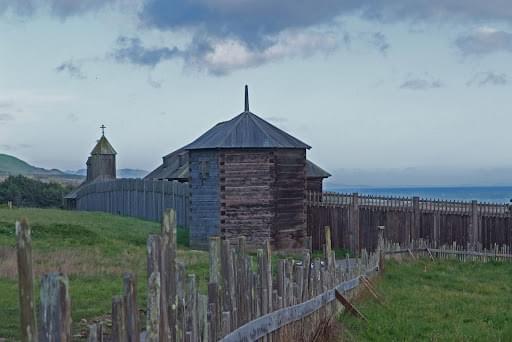
haze with the sea behind it was a complete red-brown wooden fort; had we entered
a window through time back into the past? Another halt was in order so we drove
by the sign that stated 'Fort Ross State Historic Park' and entered the lot near
a modern 'visitor center'. Phew! We were still in the 21st century!
(Fig.1)/color>
Even from a distance the fortification looked different to others seen in the
USA. A church with twin cupolas and Orthodox Christian crucifixes towered over
the walls and the bastions looked almost mediaeval. All was explained by a
friendly park ranger, the site was Russian. Alaska yes, but what were these
people doing in California? This paper hopes to explain.
Intrepid Russian promyshlenniki (frontiersmen) in search of mammals'
pelts, such as seal and sea otter, had ventured via the Aleutian Islands from
Siberia to Alaska after 1742. [1] 42 years later a colony was established on
Kodiak Island. Merchant Gregor Shelikov's enterprise was successful enough for
his widow Natalia Shelikova, with other partners, to found a 'United American
Company' in 1797. [2] As the profits poured in Czar Paul I granted a charter to
a new 'Russian-American Company'(RAC) in 1799. This was a joint-stock concern of
a similar structure to the British Hudson's Bay or East India Companies. The
initial 200 shareholders from the Russian aristocracy and royal family received
good dividends from the sale of sea otter furs, the monopoly drove out other
hunters, and a new base was built at Novo-Arckhangel'sk (Sitka). [3] As
the animals were over-hunted, new areas were explored to the south. Governor
Aleksandr Baranov negotiated with American sea captains to provide transport for
the expert Native Alaskan (Kenai, Kodiak and Alutiig) fisherman/hunters and
their skin baidarkas (kayaks). By 1804 Sitka had become a local capital,
and in1806 the RAC was granted the Czar's charter and even its own colours.
Vessels frequently visited the Californian coast, especially the natural harbour
of Rumiantsev (Bodega) Bay, despite the hostility of the Spaniards
who claimed the entire coastal waters as their jurisdiction. In April of the
latter year Nikolai Petrovich Rezanof entered San Francisco Bay to negotiate
with the governor of the Presidio for food supplies. Alaska's climate was not
conducive to agricultural and the Spanish/Mexicans were not so adept at making
domestic implements. The Alaskan settlers were short of grain & livestock so a
barter system for ironware and similar goods was offered. Governor José Joaquin
de Arrillaga and Commander José Argüello were so welcoming that, after Rezanof's
return, Baranov decided to establish a Russian colony as close to the northern
limit of Spanish territory as was possible. The Spaniards tolerated this
activity, but never endorsed it, as they required the trade relations.
As permission was sought from Russia an exploratory vessel under Ivan Kuskov
located a good site for a settlement north of Rumiantsev Bay in the
autumn of 1808 and returned for a hunting season near there in spring 1811. By
March 1812 with approval granted he had returned in the ship Chirikoff
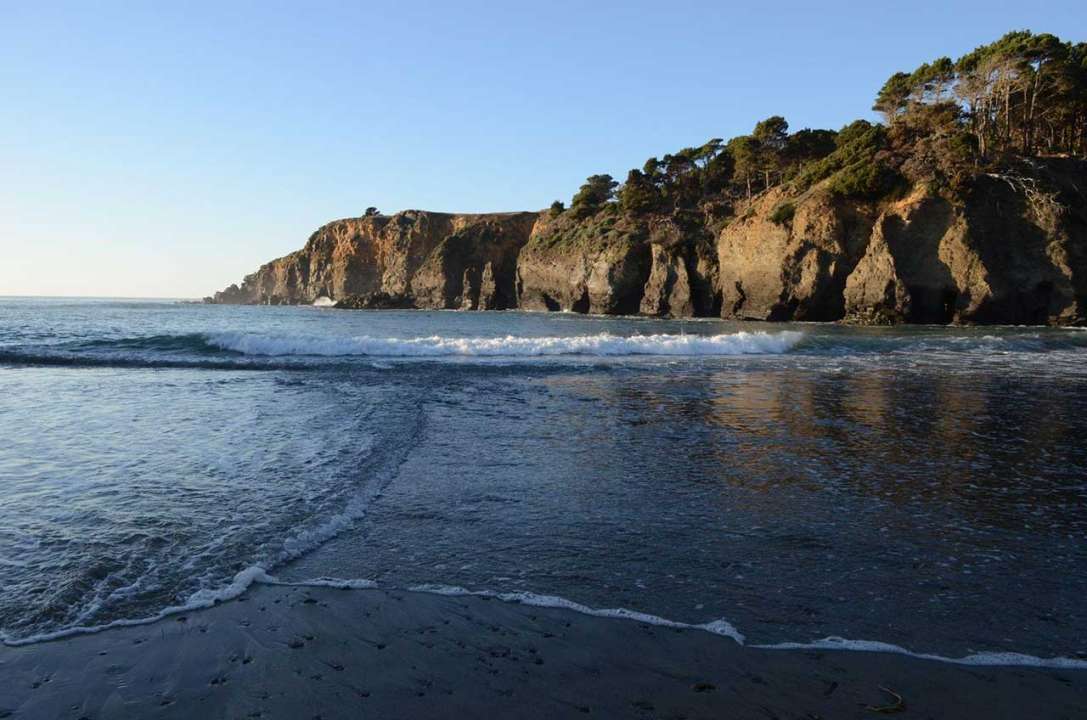
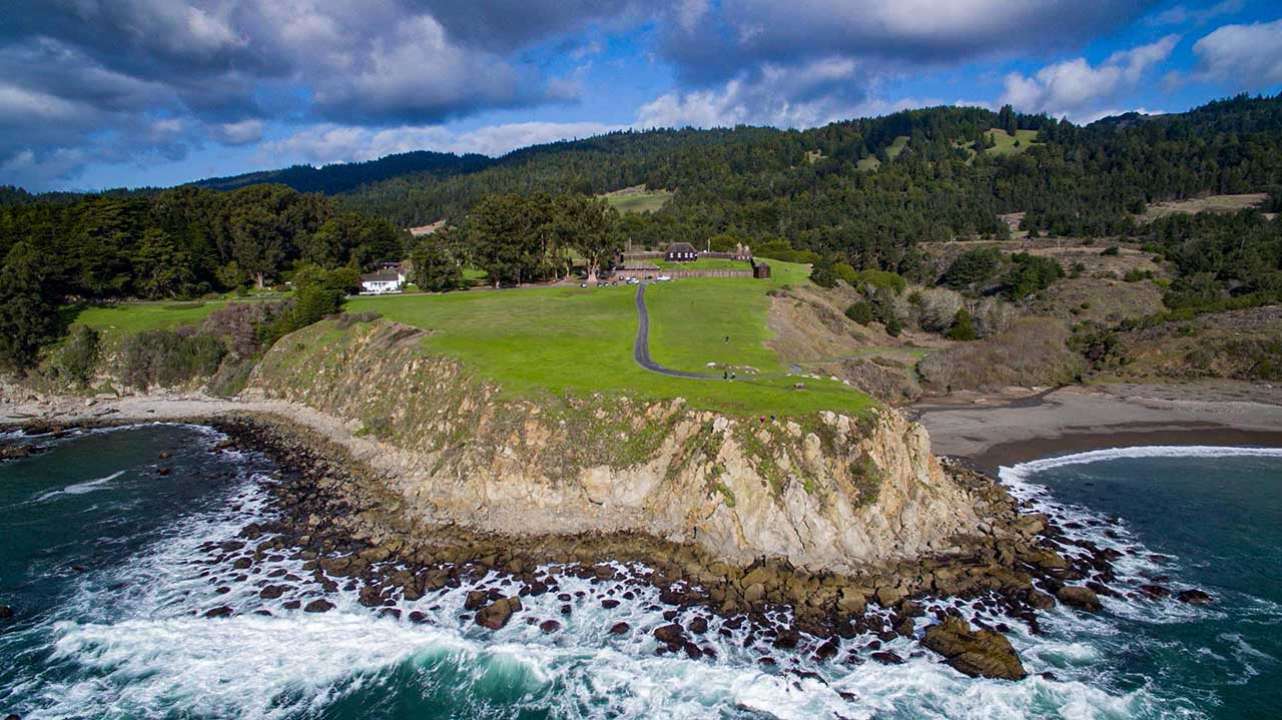
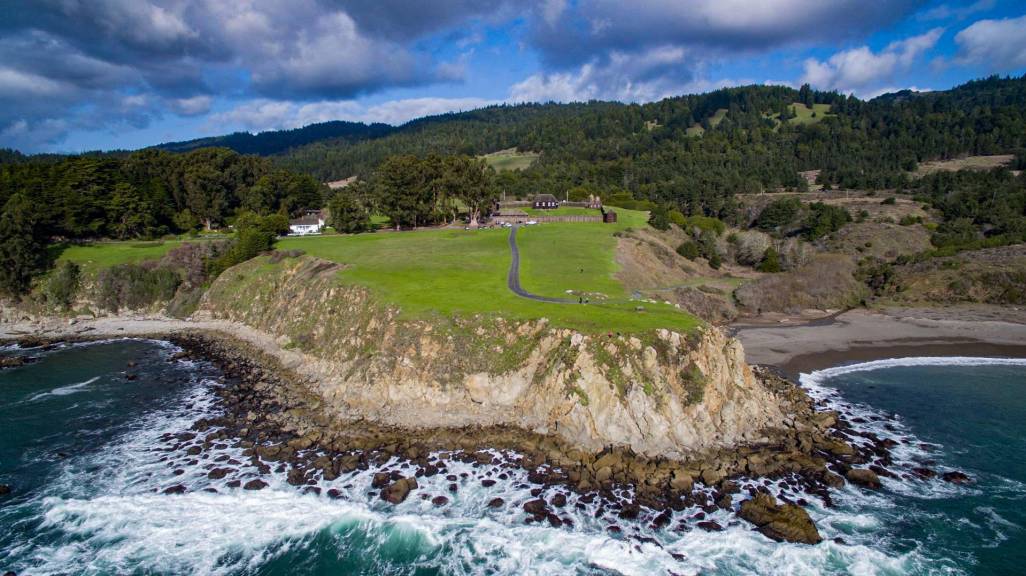
with 25 Russians and 80 Alaskans to found the colony. Sited on a bluff above a
sandy cove where two creeks entered the sea the location was 18 miles north of
Rumiantsev Bay. Probably simply known as 'Settlement Ross' or 'Colony
Ross' (possibly derived from the Russian word Rossiya for 'Imperial
Russia') it soon became Fuerto de la Rusos in Spanish or 'Fort Ross' in
English.
As the Spanish, or the local Kashaya with their village of Meteni in the
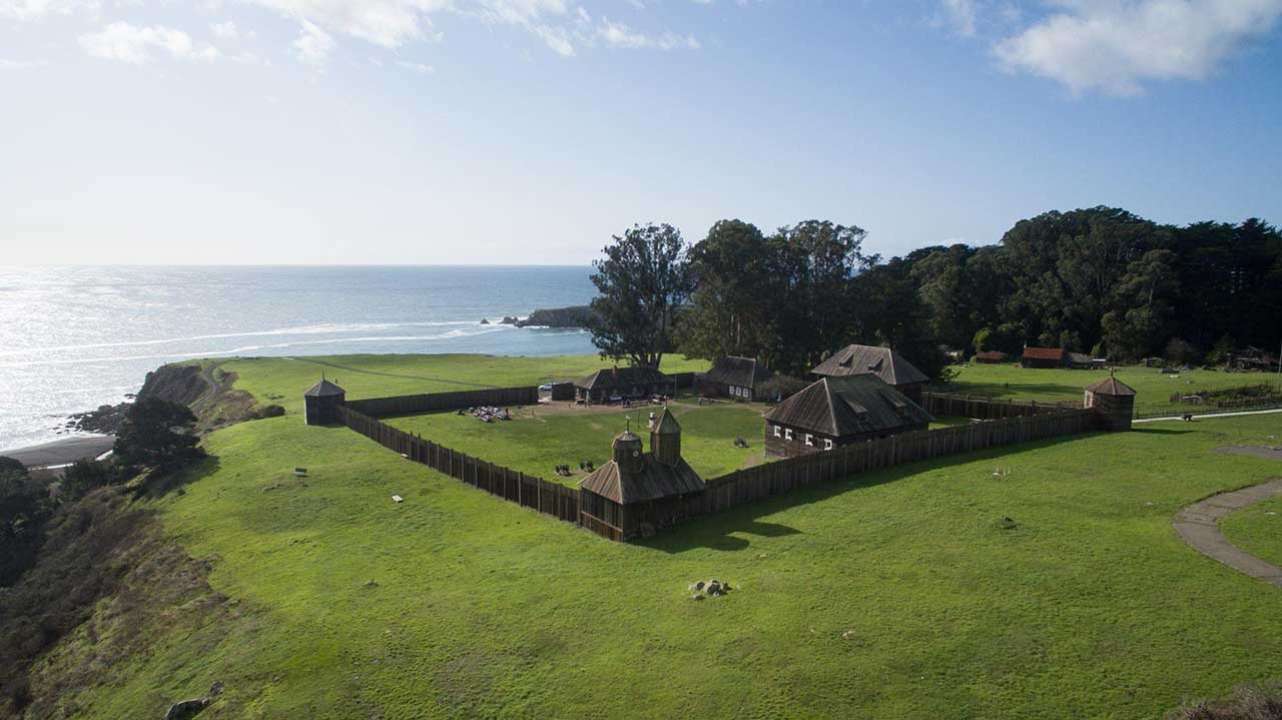
hills, were likely to be displeased by the new arrivals, a defensive perimeter
was set up, mainly for use by the officers. This had a12 feet high palisade of
redwood planks, capped with yard long wooden or iron spikes mortised to
horizontal beams at the summit, and embedded in buried logs.
(Fig.2)/color> The enclosed a rectangular area of 300 by 280 feet had a
central well. (Fig.3)/color> An octagonal and
septilateral tower with two floors flanked the south-east and north-west
corners. About 1825 a chapel was constructed on the north-east angle, on the
site of a previous bell tower. A gate passed through the southern wall towards
the sea access. (Fig.4)/color> Houses,
barracks, storerooms and domestic buildings were established inside the
stockade. Should danger threaten potential enemies could be deterred by gunfire
from 20 loopholes in the perimeter and 14 or 16 others in the turrets.
(Fig.5 &6)/color> Initially twelve cannon were
sited on the various floors of the bastions or opposite the gate. [4] Such an
assault never transpired.
Outside the compound a smithy and boathouse, carpenters', tanners' and coopers'
workshops, a bakehouse and kitchens, a series of Native Alaskan style houses, 8
bath houses and numerous agricultural sheds for keeping sheep, cattle, pigs and
horses, plus the windmill and threshing floor, were also of wooden construction.
(Fig.7)/color> Carpentry techniques from Russia were used to splice the joints
in the buildings of redwood, oak and Douglas fir. Arrangements to support the
hunters, process their captures and set up subsistence agriculture occupied the
early residents. On September 11th (August 30th in the Julian calendar) 1812 the
site was formally dedicated. [5]
Initially as a 'frontier' post armed security was a sensible precaution, but
after a few years without a threat even the militia ceased to stand sentry on a
regular basis. (Fig.8)/color> Within the
enclosure commandant Ivan Kuskov's imposing two-storey house was the most
substantial building, but the barracks for workers (although many Russians lived
outside) the clerk's accommodation and the storehouses would initially have been
perceived as last resort 'blockhouses'. Their military function was soon
forgotten. Individuals probably possessed firearms, especially the visitors such
as scientist Ilya Voznesenskii in the 1840s, whose reconstructed room still
displays a flintlock hunting-musket that doubled for personal protection.
(Fig.9)/color> As most workers cleared & fenced land, planted cereals, flax,
hemp, poppies, vegetables, squashes and tobacco the fort's defensive light
armament was housed in an armoury on the upper floor of Kuskov's house.
It was common practice for Russian cannon in redoubts elsewhere to be kept
loaded with langridge, but again this necessity would soon have ceased.
Eventually the guns may have totalled 41 altogether.
(Fig.10)/color> One bronze 4-pounder was an ex-military field piece cast at
St.Petersburg for use against the French. [6] This had a short howitzer barrel,
heavy iron bound wheels and a limber. (Fig.11)/color>
Such weapons ensured mobile defence in the case of a breach to the stockade or
gate. Its metal was never tested!
As all commercial activities in Russia were owned by the state, or on a
quasi-official relationship known as 'possessional factories', the RAC was not a
truly independent concern. [7] The government controlled all labour through the
system known as serfdom, and rigorously restricted the movement and industrial
potential of skilled personnel or entrepreneurial individuals. Some production,
such as the manufacture of firearms, was almost entirely politically managed. A
very limited number of 'private' manufacturers were allowed to obtain land, set
up premises and furnish them with equipment, but the serfs used as the workforce
were state owned, tied to the premises and no changes could be made to their
conditions of service without permission. Quotas for the government 'share' were
set in stone, and once pay agreements etc. had been set up the employer had to
abide by them, even if the process was not a success. This stifled all
innovation so that Russia was falling well behind the rest of Europe and America
by the time that Fort Ross was founded.
One advantage of the colonial arrangement was that the fort received ex-military
muskets direct from the Russian arsenals. [8] It seems that the bronze howitzer,
mentioned previously, had been found wanting against the heavier French
artillery, so had been surplused to the company, and the shoulder arms were
probably part of the same system. [9]
By early 1812 Russia had three major small arms facilities. Tula, near iron
deposits south of Brannaia sloboda (Moscow) had been founded in 1595,
drastically revised in 1712, and traditionally equipped the army. [10]
Sestroretsk adjacent to St.Petersburg close to the Gulf of Finland supplied the
navy from 1724 onwards. Izhevsk in the Ural Mountains was an expanded iron
foundry, had only started work in 1807 and had no specialist clientele. There
were some possessional factories in the Tula area but these were of minor
significance for 'common musket' production as they supplied the aristocracy and
nobility with higher quality weapons for sport and personal use.
Separate factory managements were integrated under the Ministry of War in 1808.
[11] A Quartermaster General was appointed to oversee the Ordnance Department.
Each facility had a governing board that supervised the commander of the armoury.
This individual was not permitted to use his initiative without recourse to the
governors. Within the factory a chief engineer co-ordinated the different
departments that each employed foremen and shop stewards to regulate the
gunsmiths and serf labourers. The former officials were bureaucrats not skilled
tradesman. With Russia's notoriously poor communications system to add extra
complications, the unwieldy arms industry was not designed for efficiency!
Each financial year (from September) the Military Council of the Ministry of War
made an appropriation of funds for the requirements of the armed forces. [12]
Separate armouries received a production order from the Inspector of Armouries.
Indents for resources were then sent back by the commander to the ministry for
approval. After consulting the governors the chief engineer allocated the tasks
to each tseki (workshop) based on the number of workers and weeks in the
contract period. Although employees worked for six 12hour days per week the
number of non-factory days allowed for mowing, fasting etc. often reduced the
potential output to 270 days per year. [13] Annual targets allowed for a high
wastage of materials and were often very ambitious!
Within the organisation skilled serfs carried out primary sawing, carpentry,
smithing, mechanical operations and painting, supported by others less trained
who lit fires, dug coal or fetched and carried.
(Fig.12)/color> These individuals were
indentured to the site by an obrok or 'quitrent' (a sort of deposit taken
from their wages as a deterrent to poor workmanship or absenteeism) and had a
required quota of jobs per session. The workers were allocated to the premises
by the government, could not leave unless transferred and were eligible for
conscription.
The actual gunmakers were organised into specialist guilds that formed arteli
(teams) for one aspect of production. [14] On average there were two masters,
several journeymen and the rest workmen out of a group of 20. Each team was not
allowed to move locations, had collective responsibility for their workmanship
but did not pay an obrok. As trained individuals were in short supply
they received privileges such as exemption from conscription, soul tax and the
billeting of troops in their homes. They were also able to own land or
buildings, had free access to the forest for fuel, and food at wholesale prices
from the factory commissary. Although they were banned from selling arms
privately they were granted leave to make other domestic items, such as cutlery
or samovars, and could even travel to other markets to trade with them.
As an elite 'caste' their male children were expected to follow the same trade
through an apprenticeship whether they wanted to or not.
Many of these specialists were paid a fixed hourly wage. 'Piece work' rates were
used at Sestroretsk after 1823 but often private work was of more value to the
gunmakers so motivation was poor. [15] In the same year a lack of government
orders left many workers idle even though they were not permitted to look for
other means of employment.
As one operation was completed the 'boss' of the arteli who had
distributed the original materials collected the finished items, inspected them
and paid the wages. Defective parts were returned and the team not rewarded.
When the quota was fulfilled it was passed to another workshop where the process
began again. Tula & Sestroretsk used an 'outwork' system with employees
labouring at home. Tools and furnaces varied, as did the quality of hand skills.
Izhevsk was more centralised with 14 stone buildings on one site. [16] Each
stage of the weapon often involved a journey of several miles as it was passed
around the workshops dedicated to barrels, locks, stocks, smallwork or 'armes
blanches'.
An English visitor to Tula in 1839 commented:- It surprised us to find, that
instead of having one large establishment, where all branches of gunmaking could
be prosecuted together and where all workmen could carry on in their various
departments under proper inspection, nearly all the work is performed by
blacksmiths at their own houses. When one has done to a musket all that belongs
to his branch, it is sent away to another, and so on till it has traversed Tula
a dozen times. We thus found hundreds of blacksmiths carrying about muskets from
place to place when labouring hours were over. [17] This was slightly
supercilious as both Birmingham and Liège used a very similar process at this
date. [18]
After final fitting the weapons were sent to the factory depot for inspection &
proof, stored until the contract was completed, and then forwarded to government
arsenals at Briansk, Kiev or St.Petersburg. [19] From these regiments and other
users were issued with arms. Unfortunately although the manufacturies had the
potential to produce muskets in large quantities, the use of forced labour (Tula
bought 350 serfs from Naryshkin in 1820), a lack of financial motivation for the
gunmakers who were happier making 'private' goods, and the crushing of all
entrepreneurial spirit caused constant shortfalls. By 1806 Tula was capable of
making 100,000 weapons each year but only managed 46,000. [20] Two years later
the target was 146,000 but there was a shortage of 47,000 muskets by 1810.
Almost simultaneously with the founding of Fort Ross many thousands of miles
away Napoleon's troops were massing on the River Nieman in Prussia intent on
invading Russia. [21] When the incursion started on 23rd June 1812 Csar
Alexander I had to appeal to his workers to increase output. Within weeks as
French and allied troops advanced on Moscow Tula stepped up production to 10,000
per month and repaired an additional 3,000. Possessional factories built 3,000
more. [22] Izhevsk and Sestroretsk managed 18,614, with 2,400 pistols, in the
same period. By 1815 Tula had completed 500,000 firearms. [23]
The fort would have received military weapons of a pre-1812 design on
establishment, but these may have been supplemented with later Russian models
and captured flintlocks before 1841. The current rebuilt armoury in the Kuskov
house was equipped with 40 French Fusil d'infanterie modèle 1777 at the
time of writing. [24] (Figs.13 & 14)/color> A
strong contender for the original issue had to be the Infantry musket
Obrazets 1808 goda. [25] (Figs.15, 16 & 17)/color>
This 17.78mm calibre smoothbore was 0.7kg lighter than the model of three years
before at 4.46kg. [26] It was 1.458m long and carried a socket bayonet with a
445mm triangular blade. [27] This was the weapon produced in quantity after the
Csar's appeal in 1812 and was part of his drive to modernise the industry. In
fact an imitation of the French Fusil d'infanterie modèle 1777, later
revamped as the Fusil d'infanterie modèle 1777 corrigé AN IX under the
Republican calendar for September 23rd 1801 until September 22nd 1802, it was
the most modern musket to date. [28] Russia had tried to work towards the
standardisation of gun parts since 1798, but except for the limited development
of barrel boring and grinding machines in the early 19th century this had
foundered on the reliance of hand work. [29] Although the use of barrel bands, a
nose cap and a more canted butt resembled the French prototype workmanship was
much cruder.
The bayonet was a good example of the difference in quality.
(Figs.18 & 19)/color> The original Baïonnette mle. 1777 was an
innovator with its reinforced mortise bridge, median locking ring and triple
fullered blade. It was secured to a stud beneath the barrel to prevent damage to
the foresight. The Russian shtik of 1808 had the same proportions but the
slot was left unbridged and the heavy blade was only lightened on the outer
faces. The 'cold steel' was a fundamental part of Russian warfare. Users were
only given limited training with musket fire, often clay bullets being issued
for target practice, but the idea that the bayonet charge was essential was
deeply reinforced. Scabbards were not issued so blades were fitted at all times,
and Field Marshal Alexander Vasilievich Suvorov's (1729-1800) proposal that,
"the bullet is a fool, but the bayonet is a fine lad" (pulia dura, shtik
molodets) was still accepted. [30] As the socket bayonet was a vital adjunct
to the single-shot flintlock Fort Ross would have received its quota as part of
the stand of arms.
It is possible that some other longarms, such as the English India Pattern
'Brown Bess' were also present. [31] (Fig.20)/color>
Russia obtained 60,000 of these weapons from Britain during the Napoleonic Wars.
[32] When the 20,000 survivors of the French Army returned to Prussia on 7th
December 1812 they left behind at least 550,000 troops, some 470,000 dead. [33]
Not only French (270,000) but Austrian (34,000), Bavarian (20,000), Czech
(Warsaw-35,000), Italian (45,000), Prussian (25,000), Saxon (20,000) and
Westphalian (20,000), together with assorted members of smaller states and
principalities, their weaponry lay abandoned in the Russian snow. The
much-prized muskets were collected and reissued throughout the Csar's domains.
This was the likely source of the arms that accumulated in the Kuskov house at
the fort.
The production of French & British weapons is outside the scope of this essay as
it has been explored fully elsewhere. [34] Prussian, Swedish and other muskets
were also adopted. Ammunition supply was a nightmare as the Russian forces used
28 different calibres after 1812. [35]
Despite the trepidations of the early settlers, probably generated by the memory
that indigenous-natives had destroyed the fort at Novo-Arckhangel'sk in
1802, none of the weapons were used in anger. [36]
(Fig.21)/color> As the years passed fort commanders oversaw prikashchiki
(administrators) and workers on a seven year contract. Until 1820 they received
a profit share, but after that a salary. Over-hunting caused the sea otter
profits to decline and eventually the thin soil and constant sea mists of the
Californian coast reduced agricultural output too. The establishment of orchards
of fruit trees and outlying ranches delayed the recession somewhat but the
object of creating a successful supply base for future Russian endeavours never
came to pass. After 1821 when Mexico became independent of Spain there was
sufficient gunpowder to sell to General Mariano Guadalupe Vallejo, as well as
the skill in the fort to manufacture his troops' uniforms. The population and
profitability of the site peaked in the early 1830s. There were 233 inhabitants
in 1833, with only 50 as pure Russians, the rest being Native Alaskan or
'creoles' of mixed race, and 260 in 1836. [37] Cannon and muskets would have
remained in good order in case of emergencies, but were mainly used as adjuncts
to the various holiday celebrations that were frequently enjoyed. From 1818
shipbuilding was a local trade, with craft such as schooners and brigs being
built from the generous supplies of local timber.
By April 1839 dwindling profits and friction with the ever-increasing numbers of
Mexican and American settlers that had arrived in the area caused the distant
government in St.Petersburg and the officials of the RAC to dissolve the
settlement. [38] Alexander Rotchev was ordered to sell the entire operation. The
Hudson's Bay Company, French military attaché in Mexico City, Republican
government of Mexico and General Vallejo of Sonoma all declined to buy, probably
in the latter cases as they thought potential Russian abandonment would save
them the cash! Instead an expatriate Swiss called John Sutter signed an
agreement to purchase, for $30,000-some in produce from his Sonoma holdings and
some in coin, on December 13th 1841. [39] On New Year's Day 1842 Rotchev's ship
full of settlers departed Fort Ross for Sitka, and soon afterwards John Bidwell
arrived to collect the arms and ammunition. The RAC struggled on in Alaska until
a charter extension in 1862, but eventually the United States Government
obtained the territory from the Russian government in 1867.
In less than seven years from the Russian's withdrawal, on 24th January1848,
James Marshall discovered gold at Coloma some 45 miles from the site. [40] If
ownership had been retained the history of the 'Forty-Nine Gold Rush' might have
been different!
Sutter stripped the fort of useful equipment and some buildings, and the site
had mixed fortunes and owners until acquired by the California Historical
Landmarks Committee in 1903 and then the State of California in March 1906.
Continuous restoration, archaeological research, and development of the location
as a recreational amenity has continued until the present.
As the sun ripples across the ocean that divides present Siberia from California
one can only imagine what those long dead Russians of 1812 thought as they stood
at the loopholes, muskets in hand, waiting for the enemy that never appeared.
Endnotes
[1] Anon, Fort Ross State Historic Park, California State Parks, USA,
2001, unpaginated.
[2] Watrous, S., The Cultural History of Fort Ross, < >, 18/03/06, pp.1-2.
[3] Pierce, R.A., (Editor), Essig, E.O., Ogden, A. & Du Four, C.J., Fort Ross
California, Outpost of Russian Alaska 1812-1841, Alaska History No.39,
Limestone Press, Kingston, Canada, 1991, pp. 1-25.
[4] Ibid., p. 7.
[5] Ibid., p. 6.
[6] Beck, S., 'A Brief History of Sutter's Bronze Field Cannon and a Brief
History of John Sutter', <>, 12/03/06, pp.1-3.
[7] Bradley, J., Guns for the Tsar-American Technology and the Small Arms
Industry in Nineteenth Century Russia, North Illinois University Press,
Dekalb, USA, 1990, p.64.
[8] Joy, R., pers. comm., 12th March 2006.
[9] Beck, S., Op. cit., p.1.
[10] Bradley, J., Op. cit., p. 63.
[11] Ibid., p. 64.
[12] Ibid., p. 66.
[13] Ibid., p. 80.
[14] Ibid., p. 68.
[15] Ibid., p. 78.
[16] Ibid., p. 82.
[17] Bremner, R., Excursions in the Interior of Russia Vol. 2, London,
1839, pp. 308-309.
[18] Classic Arms & Militaria, Priest, G., ‘1871 Franco-Prussian War
Snider Rifles-British Made’, Vol.9, Issue 5, Sept./Oct. 2002, pp.26-29 & ‘1871
Franco-Prussian War Snider Rifles-Part II’, Vol.9, Issue 6, Nov./Dec. 2002,
pp.18-21.
[19] Bradley, J., Op. cit., p. 82.
[20] Bogdanovic, B. & Valencak, I., Great Century of Guns, Gallery Books,
New York, U.S.A., 1986, p. 27.
[21] Haythornthwaite, P.J., Napoleon's Military Machine, Ravelin Ltd.,
Stamford, England, 1988, p. 140.
[22] Bogdanovic, B. & Valencak, I.,/fontfamily>
Op. cit./fontfamily>, p. 27.
[23] Bradley, J., Op. cit., p. 76.
[24] Joy, R., pers. comm., 13th March 2006 & <>, 09/03/06, p. 1.
[25] Deutches Waffen Journal, May 1977.
[26] Anon, 'Russian Infantry during the Napoleonic Wars',< >, 09/03/06, p. 4.
[27] Kulinsky, A.N., Russian sidearms, polearms and bayonets, Vol.II,
Atlant, St.Petersburg, Russia, 2001, pp. 52-53.
[28] Boudriot, J., Armes à Feu FrançaisesModèles D'Ordonnance, Cahier
no.3, Paris, France, 1961, pp. 1-9.
[29] Bradley, J., Op. cit., pp. 88-89.
[30] Ibid., p. 47.
[31] Joy, R., pers. comm., 13th March 2006.
[32] Anon, 'Russian Infantry during the Napoleonic Wars'., Op. cit., p.
4.
[33] Glover, M., Warfare in the Age of Napoleon, Guild Publishing,
London, England, 1980, pp. 143-145.
[34] Blackmore, H.L., British Military Firearms 1650-1850, Herbert
Jenkins Ltd., London, 1961/fontfamily> & Boudriot,
J., Op. cit. /fontfamily>
[35]/fontfamily> Anon,
'Russian Infantry during the Napoleonic Wars'., Op. cit., p. 4.
[36] Watrous, S., Op. cit., p. 3.
[37] Pierce, R.A., (Editor), Op. cit., p. 10.
[38] Anon, 'History of the Russian Settlement at Fort Ross, California', <>,
10/03/06, p. 3.
[39] Pierce, R.A., (Editor), Op. cit., p. 68.
[40] Beck, S., Op. cit., p. 3.
Captions
Fig.1. A view of the palisade and gate at Fort Ross from the south. Notice
the octagonal bastion and the wooded Sonoma foothills. (Priest)
Fig.2. The Kuskov House, home of a former manager, and chapel. The armoury is on
the upper floor. (Priest)
Fig.3. The well and typical Russian water raising system. Notice how the
stockade is constructed. (Priest)
Fig.4. Another view of the palisade. The horizontal beams secured yard long
spikes. (Priest)
Fig.5. The loophole in the south-east bastion that enfilades the wall and gate.
Each face of the tower had two similar gun ports. (Priest)
Fig.6. The simple shutter and beam that closes a loophole on the ground floor of
the north-west tower. (Priest)
Fig.7. A seaward view of Fort Ross drawn by A.B. Duhaut-Cilly in 1828. The
chapel and seven-sided bastion on the north-west are clear, as is the flag pole
and surrounding hutments. Fort Ross Creek runs in the foreground. (Courtesy of
Fort Ross State Historic Park)
Fig.8. A group of settler re-enactors in typical Russian dress. They are armed
with a variety of French, Russian and English muskets. Initially drill would
have been essential on the frontier but may soon have lapsed. Some might have
been conscripts such as the uniformed soldier. (Courtesy of Robin Joy)
Fig.9. A flintlock hunting weapon hangs from the log wall in scientist /fontfamily>
Ilya Voznesenskii's room. He was a gifted artist and was also one of the first
Europeans to climb Mount St.Helens. (Priest)/fontfamily>
Fig.10. A small calibre cannon in situ in the north-west tower. This was kept
loaded with langridge and originally would have had ropes to secure it to the
walls. (Priest)
Fig.11. A replica of John Sutters' brass howitzer on a field carriage. This
four-pounder could be moved rapidly around the site. When the fort was sold
these weapons had an interesting history. The original was removed to San
Francisco and lost in the 1906 earthquake. (Priest)
Fig.12. French workers forge musket barrels by hand in a very similar manner to
those in Russia. The quality of the workmanship varied greatly depending on
skill and materials. (Foliot)
Figs.13 & 14. An armourer repairs muskets in the reconstructed armoury at the
Kuskov House in 2006. Notice the racks of French muskets and assorted other
weapons. Powder horns for the Aleut hunters hang from the pillars. (Courtesy of
Robin Joy)
/color>Fig.15. Captioned
/color>Fig.16. Captioned/color>
Fig.17. Captioned/color>
Fig.18.
Captioned/color>
Fig.19. Captioned
/color>Fig.20. Captioned
/color>Fig.21. A modern Russian sentry armed with musket and bayonet defends
one of the bastions as the original settlers did in 1812. (Courtesy of Robin
Joy)
/color>Acknowledgements
Particular appreciation to Robin Joy and the staff at Fort Ross State Historic
Park(<www.fortrossstatepark.org>) /color>
for their help and encouragement. Also ongoing gratitude to Roger Evans, Fred
Stephens and Judy Priest. Thanks to others mentioned in the captions.